Areas for special attention for P2: punctuation, conciseness, word choice
L’Oreal, Estee Lauder, Maybelline, Neutrogena, Olay. What do all of the previously listed have in common? Yes, they are well-known brands in the cosmetics industry, but unfortunately, they are also brands that conduct animal testing for their research. According to PETA’s website, “hundreds of thousands of animals are poisoned, blinded, and killed every year in outdated product tests for cosmetics.”[1] What this means is that an innocent animal has to endure extreme amounts of pain for the sole purpose of supposedly alleviating humans from harming themselves due to unforeseen consequences of new creations. Yet, the tests aren’t always accurate and nevertheless, the products are still sold to consumers, even though they may have caused injury to an animal in the lab.
What benefits humans, harms animals. They suffer so that we don’t have to. Mice, rabbits, monkeys, cats, dogs, and countless others are locked up in laboratories just waiting in misery for the next painful experiment to be conducted on them. Due to the immense amount of stress implemented by the harmful tests, these animals usually tend to face severe psychological issues and neurotic behaviors, such as “incessantly spinning in circles, rocking back and forth, and even pulling out their own hair and biting their own skin.”[2] More than one million animals suffer, and ultimately die from tests every year; however, exact numbers are not available. This is a shocking truth that can be prevented.
The most prevalent question that runs through my mind after researching on this subject matter is ‘Why?’ Why must these helpless animals endure a life of loneliness and torment, all to die tragic death? Supporters of animal testing say that these particular experiments actually do benefit society in the sense that “virtually every medical achievement in the past century [was] reliant on the use of animals in some way.”[3] However, on the other side of the spectrum, non-supporters of animal testing argue that many, if not most, of these tests are outdated, and therefore prove no worth in the medical field. In fact, “92 percent of all drugs that are shown to be safe and effective in animal tests fail in human trials because they don’t work.”[4] Animals function differently than we do, and we simply cannot base their results on the development of products made specifically for human needs.
Although there are many companies that condone animal testing, there are even more that are making the transition to eliminate all forms of animal cruelty and continuing to find alternative ways to research their products. For example, the cosmetic company Covergirl was one of the largest brands to conduct animal testing; however, over a decade ago, Procter & Gamble’s Beauty & Grooming businesses discontinued such testing and have implemented non-animal alternative methods. “P&G is a member and key contributor to the European Cosmetics Association (COLIPA)'s Steering Committee on Alternatives to Animal Testing (SCAAT). This program funds and coordinates efforts of the cosmetic industry in the development, validation, and acceptance of alternatives to animal testing.” [5]
 |
Urban Decay's logo8 |
Another example of a well-known brand that does not promote animal testing is Urban Decay Cosmetics. On each and every one of their products, there is a cruelty-free logo that says: “We don’t do animal testing. How could anyone?”[6] This assures consumers that the company does not use or condone animal testing at all. Moreover, some products are vegan, and do not contain any animal-derived ingredients whatsoever. Smashbox Cosmetics is a similarly well-known company in the cosmetics industry that is “committed to the elimination of animal testing.”[7] These aforementioned companies, along with many others, are taking on the responsibility of not testing on animals, and are developing non-animal testing alternatives instead.
Although there are many companies that are abiding by a ‘no animal cruelty’ policy, there are certainly more that still practice inhumane tests on animals for their products. There will always be more to be done to combat the severity of this issue. The most obvious would be to have alternatives such as human clinical and epidemiological studies, human tissue and cell-based research, and sophisticated human patient simulators and models, which are more humane (not to mention, less expensive) than animal experiments.
 |
My Major is Chemical Engineering9 |
Throughout the rest of my four years at the University of Texas, I hope to pursue my passion of all things cosmetics, while simultaneously obtaining a Chemical Engineering Bachelor of Science degree and quite possibly, a Bachelor of Business Administration certificate. For the rest of my freshman year, I hope to research more about the cosmetic industry and whether or not the companies that I’m interested in purchasing from actually condone animal testing or not. If they do, I will make a list and will refrain from doing business with them in the future. I will only consume products that I know were not tested on animals. Then, I will extend this piece of knowledge to all my female friends and family members in an effort to stop supporting animal testing companies on a small scale. Later on, in my upper division courses, there is a technical area track that I can choose to take, called Product Engineering, which deals with the development of new consumer products. Within this field of engineering, I can be a part of a group that conducts research on the chemicals that are being used to create cosmetics and household products. I believe that this will give me the ability to make the effects of animal cruelty known, since I will have a say in how a company does its research. Within the next few years, I also hope to be a part of an undergraduate research team here on campus that specifically works with the production of materials and products. As for my career, it would be my dream to become a cosmetic chemist, and work for Procter & Gamble. There are many fields within a company that I could be involved in. For instance, I could be a Cosmetic Formulator who actually creates the product from raw materials. My engineering skills would certainly come in handy! Or, I could be in Analytical Services, which is the closest position that I can be in that relates to scientific research in this industry. I feel as if I would have more control over the issue of animal testing directly in the lab. On the other hand, I’m slightly interested in business, and working in Sales would also get a company’s name out in the market, favorably one that promotes an animal-free testing environment. Therefore, I believe that in order to successfully achieve these goals (both short and long-term), I will have to continue with my college education, and receive a bachelor’s degree at the very least. There is still so much to learn about this industry, from the science behind it to the actual production and design that I cannot afford to drop out of school. And even if I might be required to take so called “irrelevant” courses, such as a Visual and Performing Arts class, I will trudge on and motivate myself with the notion that after I graduate, my degree will no doubt help me in whichever career path I wish to take.
Stretch goals for this particular issue would be to eliminate animal testing in the entire cosmetics industry and to implement new and more effective ways of conducting research for new products. Consumers will no longer have to worry about whether the product that they are using was tested on a poor, defenseless animal. They will feel confident in buying a product that they know will be ethically right. All I can do now is hope that one day we will be close to achieving that goal.
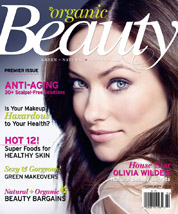 |
Beauty magazines target women10 |
The role of reading and writing may not seem quite apparent in my leadership vision; however, it can ultimately be very crucial, especially in the advertisement aspect. Eye-catching slogans and ads in women’s magazines are more likely to make female consumers pause for a second, and actually read what a company has to say about animal testing and its effects on society. This marketing technique effectively targets women whom are interested in the cosmetics industry, and successfully delivers the message. Writing also plays a large part, especially when documentation of a certain research project that is conducted without the use of animals is published. This allows the public to see the progress of science. Basically, the skills of advanced reading and writing will get the word out there that animal testing has harmful effects and should be avoided in its entirety.
The role of this course plays a unique role in my leadership vision. Coming into college as a freshman, I chose Chemical Engineering because of the fact that it involves a broad range of career opportunities as well as a strong emphasis on math and science, both of which I excel in. I have now narrowed it down to my newfound passion in the cosmetics industry. By having a college education, I knew that I wanted to have a career in which I can do something for the greater good of society. So with the assignment of this project, I immediately tied together the lesser known plight of animal testing with the well-known cosmetics industry.
Total Word Count with Quotes: 1538
Total Word Count without Quotes: 1401
Animal Testing Video11
Bibliography
1. PETA. “Caring Consumer 101.” http://www.peta.org/living/beauty-and-personal-care/caring-consumer.aspx.
2. PETA. “Animals Used for Experimentation.” http://www.peta.org/issues/animals-used-for-experimentation/default2.aspx.
3. The Royal Society. “The use of non-human animals in research: a guide for scientists.” http://royalsociety.org/uploadedFiles/Royal_Society_Content/policy/publications/2004/9726.pdf.
4. PETA. “Animal Testing Is Bad Science: Point/Counterpoint.” http://www.peta.org/issues/animals-used-for-experimentation/animal-testing-bad-science.aspx.
5. P&G Beauty & Grooming. “Animal Testing Alternatives.” http://www.pgbeautygroomingscience.com/animal-testing-alternatives.html.
6. Urban Decay. “Cruelty-Free/Vegan/Marley Approved.” http://www.urbandecay.com/Cruelty-Free-Vegan/vegan-marley-approved,default,pg.html.
7. Smashbox. “Animal Testing.” http://www.smashbox.com/customer_service/faq#animal_testing.
9. Image by Google. http://www.funnyengineering.com/Buttons/Chem/MaLeagChemBut.jpg
10. Image by Google. http://www.remyc.com/lumagazine/greenmua/OrganicBeautyMagazine_Feb09.jpg
11. Youtube. “Cosmetic Animal Testing: The Horrifying Reality.” http://www.youtube.com/watch?v=qSwR70Xtaug
[1] PETA, “Caring Consumer 101,” http://www.peta.org/living/beauty-and-personal-care/caring-consumer.aspx
[2] PETA, “Animals Used for Experimentation,” http://www.peta.org/issues/animals-used-for-experimentation/default2.aspx
[3] The Royal Society, “The use of non-human animals in research: a guide for scientists,” http://royalsociety.org/uploadedFiles/Royal_Society_Content/policy/publications/2004/9726.pdf
[4] PETA, “Animal Testing Is Bad Science: Point/Counterpoint,” http://www.peta.org/issues/animals-used-for-experimentation/animal-testing-bad-science.aspx.
[5] P&G Beauty & Grooming, “Animal Testing Alternatives,” http://www.pgbeautygroomingscience.com/animal-testing-alternatives.html.
[6] Urban Decay, “Cruelty-Free/Vegan/Marley Approved,” http://www.urbandecay.com/Cruelty-Free-Vegan/vegan-marley-approved,default,pg.html.
